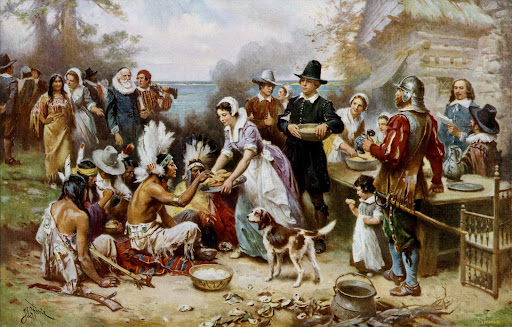
If you were raised in the American school system, it’s almost impossible to have never heard the age-old story of the first Thanksgiving. The pilgrims and the “Indians” came together for one big, peaceful feast that was full of love and prayer. Yes, some of this story is true, however it’s more of a historical fallacy; there is much more to it than just peace and food.
The first Thanksgiving took place in the fall of 1621. The only accounts of this celebration were written by Edward Winslow and William Bradford, two Plymouth colonists, and they didn’t provide an exact date, suggesting that they may have not found this event as significant as we do today. From these writings, it was concluded that the colonists were invited to rejoice and feast in celebration of their first successful harvest. It is recounted that the Europeans did not invite the Wampanoag tribe to the feast, but that some 90 indigenous men were drawn to the place when the White men fired weapons, where they were blessed with a share of the feast.
The feast consisted of venison (deer), wildfowl, and seafood like mussels, bass, and clams, along with corn, beans, squash, and nuts. It is said that the native Wampanoag brought five deer to the feast and that the seafood, due to the settlement’s location off the Eastern seaboard, was the most abundant foodstuff eaten.
However, the story of Thanksgiving, and American colonization as a whole, is not all sunshine and rainbows. The Plymouth colonists landed at Plymouth Rock in the Mayflower in 1620 after getting blown off their course to Jamestown in Virginia. They settled in Massachusetts, off the shores of Cape Cod Bay. To their annoyance, there were Native American tribes roaming this territory who felt they needed to protect and preserve their lands. The nearest tribe was the aforementioned Wampanoag tribe.
Almost immediately after settlement, hoards of indigenous people began dying due to disease. The Europeans were bringing diseases to the Americas that the Native Americans didn’t have any immunity to, the most rampant of which was smallpox. These disease-caused deaths decimated Native populations, making them more vulnerable to capture and forcing the Wampanoag to play nice with the colonists so they weren’t overtaken by their rival Narragansett tribe or the Mi’kmaqs in modern-day Quebec, New Brunswick, and Nova Scotia.
In March of 1621, the Wampanoags signed a treaty with the European colonists that confirmed an alliance between the parties. It didn’t do much for the Native Americans, but it helped them not be at constant war until more settlers came in 1630. It provided that any indigenous person guilty of assaulting a colonist would be subject to English law and it reaffirmed that the English would not see their native neighbors as equal and that this land was God-given to the English colonizers. This treaty makes Thanksgiving seem like a coerced and manipulated event. The Wampanoag just didn’t want to be killed by rival tribes or by the English, so they complied.
Thanksgiving wasn’t even made a federal holiday until 1863, over 200 years later, when President Abraham Lincoln declared that the last Thursday of November should be celebrated as the day of Thanksgiving. He did this during the Civil War to give the United States something hopeful and nostalgic to look to in order to get past that cataclysmic period. It was made a federal holiday in 1941 by President Franklin D. Roosevelt, who proclaimed Thanksgiving would be held on the fourth Thursday of November.