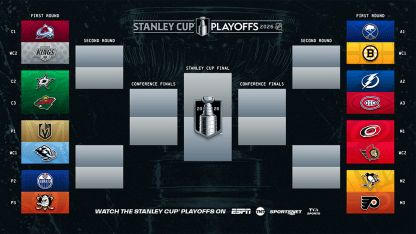
To absolutely nobody’s surprise, the Colorado Avalanche completed the sweep of the Los Angeles Kings last Sunday and moved onto the second round. In their Round One matchup, there was some speculation about whether Colorado was playoff-ready or if they weren’t. They didn’t score more than five goals in the entire series when they would put up seven, eight, even nine-goal games in the regular season. Despite some disappointment, the Avs were second round-bound.
Colorado was waiting to see who won in the other Central Division match-up between the Dallas Stars and the Minnesota Wild. Dallas blundered game one at home, losing 6-1. They came back in games two and three, winning 4-2 in game two, and 4-3 in double-overtime in game three. However, the State of Hockey won games four, five, and six to win the series 4-2 in come-from-behind fashion after being down 1-2. This meant that two of the best teams in the league in Colorado and Minnesota were set to face off in the second round.
Now, as an avid ‘X’ user (formerly known as Twitter) in the hockey world, I saw a lot of disappointment with the Avs’ performance in round one and extremely low expectations for what they could do against powerhouses like Minnesota or Dallas. But, from the start of this discourse, I jumped online to defend the Avalanche. Colorado is a deep, high-powered team both offensively and defensively. In the regular season, they ranked #2 in 22+ mile-an-hour speed bursts, spend above average time in the o-zone, and below average time in the d-zone. They also ranked #1 in total shot locations, 6th in high-danger chances, and #1 in mid/long-range shots.
In the playoffs so far, Colorado has spent below average time in both the defensive zone and offensive zone, while spending more time in the neutral zone than usual. This was due to the defensive style of play that LA buys into. They play a 1-3-1 neutral zone trap that clogs up the neutral zone and makes entries nearly impossible. This stifles rush chances that Colorado’s offense is powered by and forces neutral zone turnovers that the Avs then have to defend against. This style of play reduces overall game speed, which is not ideal for a rush team like Colorado–I’ll explain.
Colorado runs a high-paced, offensive rush style of play. They’re centered around rapid transition and they utilize their roaming d-core to lead rushes and pinch deep in the offensive zone. Colorado likes to play fast, Los Angeles doesn’t–they’re okay with defending, defending, defending, where Colorado looks to simply outscore their opponent. Los Angeles slowing down play for such a fast and aggressive team took some getting used to for the Avalanche.
When discourse began and people lost hope that the Avs would be able to finish off the Central, I clogged up the timeline with this idea: When the Colorado Avalanche meet a team that plays as fast as them, a team that can defend in their own zone and activate their D up North, a team that has as many skilled forwards as they do defenseman, a team that actually has depth scoring, they will find their game and deliver those electric regular-season-performances we’re all used to. Their Round Two opener against Minnesota proved my hypothesis to be true.
From puck drop this game was wired. Spirits were high and Ball Arena was buzzing, as were the boys on the ice. Only tw0-shifts into the game, Colorado defenseman Cale Makar had to leave the game after taking an awkward hit from Marcus Foligno of the Minnesota Wild. The key match-up of the series is Makar and Quinn Hughes, so Makar heading down the tunnel so early was not a good sign. The Avs then had to play with only five D, Sam Malinski filling in for Makar. Malinowski did his best Cale Makar impression 11 minutes into the first, walking the Wild defense and scoring from the circle for a 1-0 Colorado lead. Jack Drury followed up less than a minute later, putting the Avs up 2-0. Then, they let The Dogg off the leash.
I’d hate to see Nathan MacKinnon coming full-speed down the ice on the power play straight at my body, but that’s what the Minnesota Wild penalty killers got. And The Dogg made it count. He came flying down the ice, through the D, into the slot and fired a wrister on goal. Wallstedt made the initial stop but MacKinnon got his own rebound, putting up an insane seam pass to Arturi Lehkonen, who wristed it home for the 3-0 lead. Minnesota had the answer though, biting into the 3-0 lead with two goals from Marcus Johansson and Ryan Hartman. Through one period, there were five different goals scored across both teams.
Good news was that Makar was back for the second period, and he picked up right where he left off. Colorado demonstrated their impeccable rush game, as Makar picked a shot up from the crease, sprung big Valeri Nichushkin, who tossed a perfect saucer pass to Nick Blankenburg for a 4-2 lead. But, the Colorado offense stalled for a bit in the second, blowing a 3-0 lead and allowing Minnesota to tie the game at four off goals from Vladimir Tarasenko and Quinn Hughes. Not only did the Wild tie it, but the same power play that had been Colorado’s Achilles Heel gave up another short handed goal from Marcus Foligno. The Wild, after being down 3-0, took a 5-4 lead in the second. But, Devon Toews had the answer, tied it up at five with a wrist shot from the top of the slot.
At the start of the third, the game was knotted at fives, but Makar said to Hughes, “Whatever you can do, I can do better,” and right off the face-off he wiggled those Shakira hips, and walked right down the circle, and fired it home. Set up from MacKinnon, they both picked up their second points of the night, and the Avs restored their lead (6-5). 2:22 later, Nazem Kadri was sprung through the zone after Devon Toews blocked a shot, and he scored for the 7-5 lead. Mats Zuccarello cut into the lead with a goal assisted by Hughes and Matt Boldy, but Makar, again, told Quinn Hughes that he has two Norris Trophies for a reason, and he scored his second of the night, walking the D, and firing it home for the 8-6 lead. Late in the third, the Wild, desperate for two, pulled Wallstedt for the extra attacker, but Nathan MacKinnon read their rink-wide passes all day, he intercepted one, and he wristed it home from inside the blue line for the ninth Colorado goal of the night.
Toews finished with four points on the night, Makar, Necas, and MacKinnon all left with three. This game, while it may seem like a fluke where defense and goaltending seemingly wasn’t an option, proved my point. Colorado, while they’re defense and goaltending is usually locked, is okay with allowing goals against and outscoring their opponent. They thrive in those end-to-end, high-offense situations that LA doesn’t provide. Minnesota is another rush team with offensive defenseman like Faber and Hughes that can try to match Makar and Toews. This environment fuels Colorado’s play style, which allowed them to win the game in such an electric 9-6 fashion.
Exactly like I thought would happen, the Colorado Avalanche met their match and are back to being that dangerous offensive team we all know and love them to be. Because Minnesota and Colorado are both such fast and aggressive offensive teams, MacKinnon, Makar, and Necas got going after a slow first round. Now that The Dogg has woken up, Minnesota should be scared of what they’ve poked. If this is what the rest of this series is going to look like, I’ll be tuned in every night (I will be anyway).